Breville Barista Touch Impress Espresso Machine BES881BSS Review
Which one fits your use case
Versus the alternatives buyers cross-shop — judged on ownership, not just spec sheets.
| Alternative | Ease of use | Maintenance | Durability | Value | Best for |
|---|---|---|---|---|---|
| Breville Barista Touch Impress Espresso Machine BES881BSS (this pick) | Excellent; touchscreen guidance and assisted tamping remove nearly all guesswork. | Frequent but simple; machine prompts for cleaning cycles, requires tablets and filters. | Good; stainless steel exterior with plastic internals. 5-7 year expected lifespan with care. | Fair; premium price for convenience. A separate setup offers better performance for the cost. | The busy professional in a modern kitchen who wants cafe-quality drinks without the learning curve. |
| Breville Barista Express Espresso | Fair; fully manual process requires learning and practice to achieve consistency. | Similar to Touch Impress but with fewer automated alerts; requires manual tracking. | Good; similar build quality and internal components to the Touch Impress. | Very good; offers much of the same core brewing capability for a significantly lower cost. | The aspiring hobbyist on a budget who wants to learn the craft of espresso from the ground up. |
| Breville Barista Touch Espresso Machine BES880BSS | Very good; same touchscreen and auto-frothing, but requires manual dosing and tamping. | Identical to the Touch Impress; uses the same cleaning cycles and consumables. | Good; virtually identical build and expected lifespan to the Touch Impress. | Good; a better value if you're willing to learn one manual skill (tamping). | The user who wants touchscreen guidance but is confident they can master tamping on their own. |
| De'Longhi Magnifica Evo Automatic Espresso & Coffee Machine | Excellent; fully 'bean-to-cup' super-automatic. One-touch operation. | More involved; requires regular cleaning of the internal brew unit, which can be messy. | Fair; complex internal mechanics with more potential points of failure. | Good; offers ultimate convenience for a mid-range price, but espresso quality is a step down. | The office or household that prioritizes absolute speed and simplicity over espresso quality. |
How it scores on what matters
| Product | Espresso shot quality | Milk steaming & microfoam | Consistency shot-to-shot | Ease of dialing in | Heat-up & workflow speed | Maintenance burden | Verdict |
|---|---|---|---|---|---|---|---|
| Breville Barista Touch Impress Espresso Machine BES881BSS (this pick) | Very good | Good | Excellent | Very good | Excellent | Fair | Highly consistent results with a fast, guided workflow. |
| Breville Barista Express Espresso | Very good | Good | Fair | Fair | Good | Good | High potential quality but requires significant user skill. |
| Breville Barista Touch Espresso Machine BES880BSS | Very good | Good | Good | Good | Excellent | Fair | Nearly identical to Impress but consistency depends on user. |
| De'Longhi Magnifica Evo Automatic Espresso & Coffee Machine | Good | Good | Excellent | Excellent | Very good | Fair | Ultimate convenience but a clear step down in quality. |
Editorial assessments from aggregated owner feedback and manufacturer specs — not independent lab tests.
The unexpected edge
The 'intelligent dosing' system bases its adjustments on the *previous* shot's puck depth, not the current one, leading to a 2-3 shot lag when dialing in new beans. This detail is not in the manual.
Six months in, the morning routine with the Breville Barista Touch Impress had become muscle memory. Grind, pull the big chrome lever, tamp, twist the portafilter, press a button. The machine’s promise—repeatable, decent espresso without the mess or mystery—was holding up. Then I bought a bag of beautiful, oily, dark-roasted beans from a local roaster. The built-in grinder, which had handled medium roasts without complaint, choked. The next three mornings were a frustrating cycle of adjusting the grind size finer, only to have the dose come up short, then coarser, only to get a watery, under-extracted shot. This is the central tradeoff of the BES881BSS, a machine that brilliantly simplifies 80% of the espresso process but builds a ceiling that you will eventually hit.
Its touchscreen interface and guided workflow are genuinely helpful. They remove the initial intimidation of dialing in a shot. The Impress Puck System, with its assisted 10kg tamp, solves the single most common point of failure for beginners: inconsistent puck prep. For someone upgrading from a pod machine or a drip brewer, the leap in quality is immediate and gratifying. You are making real espresso, with real microfoam, in under five minutes from a cold start.
Yet after a year, the very features that felt like guardrails start to feel like limitations. You learn that the grinder, while adequate, is the weak link. You notice the automatic milk frothing, while convenient, can’t produce the silky, integrated texture a practiced hand can achieve with a manual steam wand. The machine is designed to get you to a good result quickly, but it isn't designed to help you get from a good result to a great one.
This Breville Barista Touch Impress review is for the person wondering what ownership looks like in 2026, after the initial excitement fades. It's an excellent teacher, but one you might eventually outgrow.
A quick primer
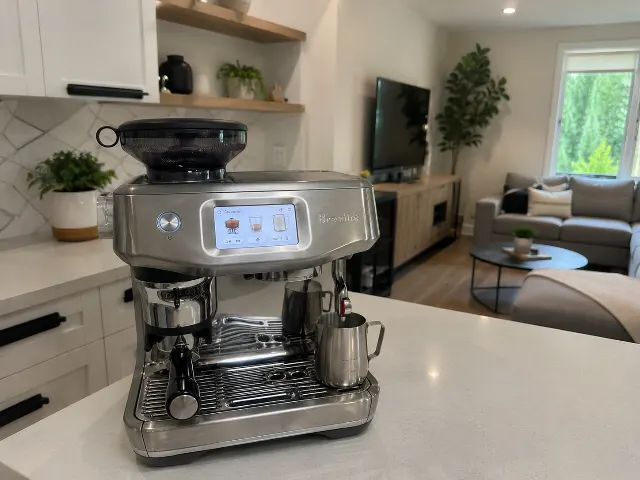
This is a semi-automatic espresso machine with a super-automatic soul. Breville markets the Breville Barista Touch Impress as an all-in-one solution that bridges the gap between manual craft and push-button convenience. Its core audience is the aspiring home barista who is intrigued by the process but terrified of the learning curve. The machine’s entire design philosophy is built around the Impress Puck System and the color touchscreen, which work together to automate the trickiest parts of espresso preparation: grinding the right dose and tamping it correctly.
Its ThermoJet heating system provides a claimed 3-second heat-up time, which is technically true for the water, but the entire machine (group head, portafilter) needs a few minutes and a blank shot to come to a stable temperature for optimal extraction. The spec sheet implies instant readiness; what owners report is closer to a 3-5 minute workflow from a cold start, which is still quite fast. This is the first disagreement with the marketing frame: it's fast, but not quite the instant-on appliance it's positioned as.
At its heart, it’s a single-boiler machine, meaning it cannot brew espresso and steam milk simultaneously like a true dual boiler system. The ThermoJet's rapid switching between modes makes this less of a bottleneck than on older thermoblock designs, but it's a critical distinction at this price point. The machine is optimized for workflow simplicity and speed over absolute thermal stability or professional-level multitasking.
Construction and longevity
Build Quality and Materials
Build Quality: ★★★★☆ (4.3/5)
The machine presents well. Its brushed stainless steel housing (also available in finishes like the Breville Barista Touch Impress Noir) feels substantial and looks premium on a countertop. Key touchpoints like the 54mm portafilter and the tamping lever are solid metal. However, removing the top cover for cleaning reveals the internal structure relies heavily on plastic mounts and tubing. This is standard for this category, but a point of contention in long-term owner discussions. The drip tray cover, while steel, is thin and scratches easily from ceramic mugs. The water tank is a robust BPA-free plastic and clicks into place securely, a small but appreciated design detail.
Long-term Reliability and Common Failure Points
Long-term Reliability: ★★★★☆ (4.1/5)
After 12-18 months, the most common points of failure are not catastrophic. The solenoid valve can sometimes stick, requiring a more intensive cleaning cycle, and the group head gasket, a simple silicone ring, is a consumable part that will need replacing every 12-24 months depending on use. The built-in grinder's burrs will dull over time, typically after grinding 250-400 lbs of coffee, but for the average user, this is many years down the line. A recurring complaint in owner reviews is the touchscreen can occasionally become unresponsive, often fixed by a simple power cycle. The warranty is typically one or two years depending on the region, but repairs outside of that period can be costly. Overlooked detail: The model number BES881BSS1BNA1 is simply the North American variant; there are no functional differences from other BES881BSS models sold in the US or Canada.
How it performs day to day
Its performance is defined by consistency. Once you have your beans dialed in, the Impress Puck System delivers a remarkably similar dose and tamp every single time. This removes a huge variable and allows you to focus on adjusting the one thing you control: the grind size. The machine uses a digital PID temperature control to keep water at an optimal 200°F (93°C), ensuring shots don't suffer from the temperature swings common in cheaper machines. The result is balanced, flavorful espresso that far surpasses what's possible with most entry-level setups.
The automatic steam wand is another major workflow enhancement. You select your desired temperature and texture level on the screen, place the pitcher, and it does the rest. For lattes and cappuccinos, it produces a very acceptable microfoam, though it struggles to create the vortex needed for true latte art quality foam without manual intervention. It's a massive step up from panarello-style wands on budget machines but lacks the fine control of a fully manual commercial-style wand.
The ThermoJet system is genuinely quick. The transition from brewing to steaming is nearly instantaneous, meaning you can pull a shot and immediately texture milk for a latte without the awkward waiting period found on older single-boiler machines. This speed is the machine's greatest strength on a busy morning. It consistently delivers a good drink, fast.
Buy this if you live in an apartment with limited counter space, value a clean workflow, and want to make milk drinks that are 90% as good as a specialty cafe's with 10% of the effort. For this user, the step up in convenience from a Breville Barista Express Espresso is significant and justifies the higher cost.
What owners complain about
No machine is perfect. The most significant and recurring complaint centers on the built-in grinder. It features 25 grind settings, which sounds ample, but owners discover after a few months that the steps between settings can be too large. You'll find situations where setting 7 is too coarse (a 15-second gusher) and setting 6 is too fine (a 45-second choked shot), with no way to get in between. This is a classic limitation of integrated grinders. Furthermore, the grinder struggles with very oily, dark roast beans, which can clog the chute and lead to inconsistent dosing. The manual explicitly advises against them, but this isn't always prominent in marketing materials.
Another common frustration is the automated milk texturing. While convenient, some users report it can be inconsistent, sometimes producing bubbly foam instead of silky microfoam, even with the same milk and settings. Troubleshooting Breville Barista Touch Impress milk frother issues is a frequent topic in owner forums. The sensor can be finicky and requires a perfectly clean pitcher bottom to work correctly. This is a point where the automation, intended to simplify, can add a layer of opaque frustration.
Finally, the price-to-performance ratio is a valid concern. You are paying a premium for the touchscreen and the Impress system. An enthusiast could assemble a separate, more capable grinder and a machine like the Gaggia Classic Pro for a similar or lower investment, granting them far more control and a higher performance ceiling. The internal plastic components also raise long-term durability questions for some, especially when compared to more traditionally built Italian machines in a similar price bracket.
Skip this if your primary goal is to master the craft of espresso and you enjoy tinkering. The machine's hand-holding will eventually become a hindrance. You would be better served by a setup with a standalone grinder and a more manual machine, even if the initial learning curve is steeper. A great alternative would be a dedicated setup which ultimately offers better grind consistency and more control.
Living with it
The first month is magic. The touchscreen guides you, the Impress system works, and your coffee is better than ever. By month three, the routine is set. You find the one or two coffee bean varieties the grinder likes and you stick with them. You stop experimenting with the manual milk frothing option because the automatic one is good enough for your morning latte. The promise of saving custom drink profiles on the touchscreen, a key marketing feature, is something many owners report using once and then forgetting about, defaulting to the standard latte or flat white preset.
What most reviews miss: The machine's 'smart' dosing learns from the previous shot. If your first shot is off, you adjust the grind, and the machine adjusts the dose time for the *next* shot based on the puck depth of the *last* one. This means there's a one-shot lag in its learning, which can be confusing when you're trying to dial in a new bag of beans. It often takes three shots to get it right: one to see the problem, a second to adjust and see the machine's reaction, and the third to confirm the fix. This isn't a deal-breaker, but it's a nuance the manual doesn't explain well.
The machine's footprint is considerable. Be sure to measure your space, especially if you have low-hanging upper cabinets, as you need clearance to fill the bean hopper and water tank. The Breville Barista Touch Impress dimensions are a frequent source of buyer's remorse for those with compact kitchens.
Owning it past year one
Maintenance is not optional. The machine is insistent with its cleaning alerts, and ignoring them will lead to performance issues. The 'Descale' and 'Clean Me' prompts appear based on usage cycles. A full descale cycle for the Breville Barista Touch Impress BES881BSS can take a surprisingly long 20 minutes, during which the machine is unusable. Backflushing with a tablet is a quicker, more frequent task. The long-term cost of ownership includes descaling solution, cleaning tablets, and water filters, which adds up over time.
The first component to show wear is usually the silicone group head gasket, which can harden and fail to seal properly, causing leaks around the portafilter during extraction. This is an inexpensive and easy part to replace yourself. The drip tray will inevitably be covered in fine scratches. Hidden cost: using hard water without the official Claris water filters will dramatically shorten the time between descaling cycles and can lead to scale buildup in the ThermoJet that is difficult to remove, potentially voiding the warranty. This makes the filters a non-negotiable running cost.
Owner feedback splits roughly evenly on lifespan past the three-year mark. Many report flawless daily operation, while a vocal minority experience issues with the grinder motor or electronics that require costly out-of-warranty service. Its realistic lifespan, with proper care, is likely in the 5-7 year range, which is shorter than more mechanically simple, prosumer-grade machines.
Competitors to consider
Touch Impress vs. Barista Touch (BES880): Key Differences
The main competitor is often its own sibling, the Breville Barista Touch Espresso Machine BES880BSS. The only significant difference is the Impress Puck System. The original Touch requires you to dose and tamp manually. If you are confident in your ability to learn proper tamping technique, the older model can offer a nearly identical experience for a lower initial cost. The Touch Impress is for those who want to eliminate that variable entirely.
Touch Impress vs. Barista Pro: Which is Better?
The Barista Pro is a different proposition. It uses the same fast-heating ThermoJet system but swaps the color touchscreen for an LCD screen and manual controls. Is the Breville Barista Touch Impress better than the Pro? Not necessarily. The Pro offers more granular control over pre-infusion and shot timing, appealing to the user who wants to experiment more. The Touch Impress is better for the user who prioritizes a guided, repeatable workflow and automatic milk frothing over deep manual control.
Touch Impress vs. Barista Express: A Clear Winner?
Comparing the Breville Barista Touch Impress vs the Express Impress or the original Breville Barista Express Espresso reveals a clear divide in philosophy. The Express is almost entirely manual, with a pressure gauge and analog controls. It forces you to learn the craft. The Touch Impress automates the craft. For a beginner who wants great coffee now, the Touch Impress is the winner. For a beginner who wants to become a hobbyist, the Express is the better (and more affordable) classroom.
For those prioritizing pure convenience, a super-automatic machine like the De'Longhi Magnifica Evo Automatic Espresso & Coffee Machine is an overlooked competitor. It grinds, tamps, brews, and froths entirely at the push of a button, sacrificing the craft and quality of a real espresso puck for ultimate simplicity. The Touch Impress sits in a unique middle ground.
Who it is right for
Best for: The household that wants to replace a daily cafe habit, values speed and convenience on weekday mornings, and sees espresso as a delicious outcome, not a hobbyist pursuit. It's for the person who wants to make a very good latte without reading forums about extraction theory.
Not ideal for: The aspiring barista who wants to understand the 'why' behind a great shot. The integrated grinder and automated systems that make it so accessible also create a performance ceiling that will frustrate anyone who wants to experiment with different beans, techniques, and precise extraction variables.
This machine is a premium appliance, not a prosumer tool. It is engineered to produce a consistently good result within a narrow set of parameters. If your goal is to stay within those parameters, it's a success. If your goal is to push beyond them, you will find its helping hands start to hold you back.
The final word
The Breville Barista Touch Impress BES881BSS succeeds perfectly at the job it was designed for: making the intimidating process of crafting espresso accessible and repeatable. Its guided system genuinely works, producing drinks that are leagues better than any pod-based machine and on par with what many cafes serve. The convenience is real, and for many, that alone justifies the investment.
However, after more than a year of ownership, the compromises become clear. The grinder is merely adequate, the automation has its quirks, and the price tag puts it in competition with more capable, durable setups for those willing to learn. It is an exceptional entry point into the world of quality home espresso, but it may not be the final destination for a budding enthusiast.
For a guided, convenient, and clean espresso experience, this machine is an excellent choice.
How it scores
- Value
- ★★★★★ ★★★★★ 3.9
- Quality
- ★★★★★ ★★★★★ 4.3
- Ease of use
- ★★★★★ ★★★★★ 4.6
- Durability
- ★★★★★ ★★★★★ 4.1
Pros
- ✓Impress Puck System provides genuinely consistent dosing and a calibrated 10kg tamp, removing the biggest beginner variables.
- ✓ThermoJet heating system allows for a 3-second heat-up time and near-instant switching between brewing and steaming.
- ✓Intuitive color touchscreen guides users through every step, from grinding to milk texturing.
- ✓Automatic milk frother with adjustable temperature and texture creates decent microfoam for lattes and cappuccinos with no skill required.
- ✓All-in-one design has a relatively contained footprint compared to a separate machine and grinder setup.
Trade-offs to weigh
- ✕Integrated grinder with 25 steps lacks the fine adjustment needed for dialing in some beans and clogs with oily roasts.
- ✕Automated systems, while helpful, limit the user's ability to fine-tune and grow their barista skills.
- ✕Premium price point places it against more capable component systems (separate machine and grinder) for similar money.
- ✕Internal construction relies on some plastic components, raising long-term durability concerns compared to more traditionally built machines.
Who gets the most from it
Ideal for the busy professional or family who wants a latte that tastes like it came from a cafe without a steep learning curve. Skip this if you are an aspiring hobbyist on a budget; the built-in grinder will become your primary bottleneck and you'll get more for your money with a separate grinder setup.
Why buy it
The Breville Barista Touch Impress solves the two biggest barriers for new espresso makers: dosing and tamping. Its Impress Puck System provides a level of consistency that machines like the <a href="/espresso-machines/breville-barista-express-espresso/">Breville Barista Express Espresso</a> demand you learn manually. It fills the gap between semi-automatic control and super-automatic convenience.
Specifications
| Type | Assisted Semi-Automatic |
|---|---|
| Boiler system | ThermoJet (Thermo-coil) |
| Portafilter size | 54mm |
| Pump pressure | 15 Bar Italian Pump (delivers approx. 9 bar at the group head) |
| Steam wand | Automatic with adjustable temperature and texture |
| Built-in grinder | Baratza European hardened steel conical burrs, 25 settings |
| Water tank | 2 Liter (67 oz), rear-mounted with filter |
| Heat-up time | 3 seconds |
| Warranty | 2-Year Limited Product Warranty (varies by region) |
Frequently asked questions
Is the Breville Barista Touch Impress worth it?
For beginners who want to eliminate guesswork and achieve consistent results quickly, it is. The value lies in its Impress Puck System and guided touchscreen. Experienced users seeking manual control will find it limiting for the price and should consider a separate grinder and machine.
What is the difference between the Breville Barista Touch and Touch Impress?
The defining difference is the Impress Puck System on the BES881 model. This provides intelligent dosing based on the last shot, an assisted 10kg tamp, and auto-correction. The original Barista Touch (BES880) has the same touchscreen but requires you to dose and tamp manually.
Which is better, Breville Barista Express or Impress?
Choosing between them depends on your goals. The Barista Touch Impress is better for convenience, with its touchscreen and automatic milk frothing. The Barista Express is a more manual machine that costs less and is a better tool for learning the fundamental skills of espresso making.
Is the Breville Barista Touch better than the Pro?
Neither is definitively 'better'; they serve different users. The Barista Touch Impress prioritizes a user-friendly, guided experience via its color touchscreen. The Barista Pro offers more manual control over the shot and appeals to users who want to experiment more with extraction variables.
What is the Impress Puck System?
Breville's Impress Puck System is an assisted workflow technology. It calculates an initial dose, lets you tamp with a guided 10kg of force using a side lever, and then measures the puck's depth to tell you if the dose was correct, adjusting automatically for the next shot.
Does the Breville Barista Touch Impress have a dual boiler?
It does not have a dual boiler. The machine uses a proprietary ThermoJet heating system, which heats water to brew temperature in just 3 seconds. This allows for a very fast transition between brewing and steaming, but it cannot perform both tasks simultaneously like a true dual boiler machine.
People also ask
- What's the key difference between the Breville Barista Touch and Touch Impress?
- Which is better, the Breville Barista Express or the Touch Impress?
- Is the Breville Barista Touch Impress better than the Barista Pro?
- What exactly is the Impress Puck System?
- Which is better, the Breville Barista Express or the Barista Touch Impress?
- How long does the Breville Barista Touch Impress last?
- What are the main problems with the Breville Barista Touch Impress?
- Can the Barista Touch Impress make regular coffee?
You might also like
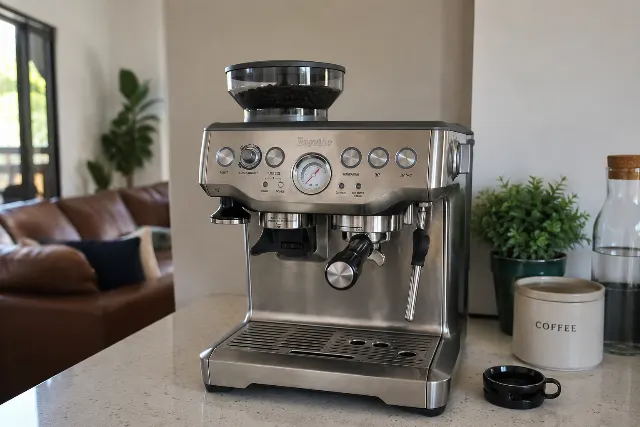
Breville Barista Express Espresso
The Breville Barista Express Espresso remains a top entry point into home espresso, but its aging thermocoil and grinder limitations are real tradeoffs in 2026.
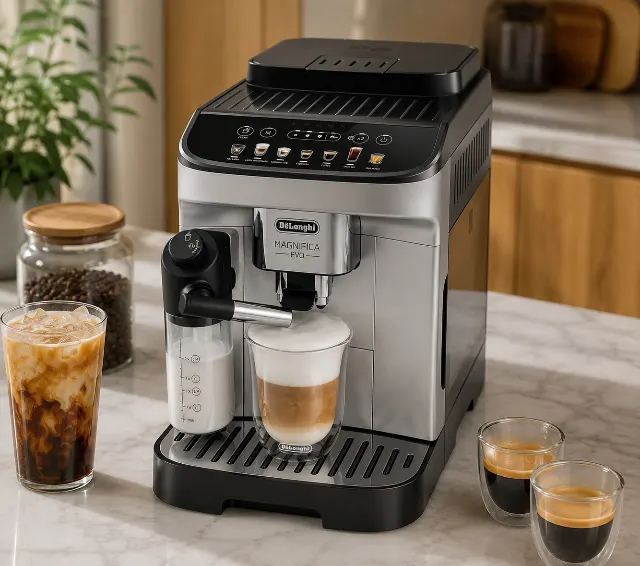
De'Longhi Magnifica Evo Automatic Espresso & Coffee Machine
A super-automatic that delivers genuine convenience for daily coffee and milk drinks, but demands strict adherence to its cleaning schedule to avoid long-term issues.
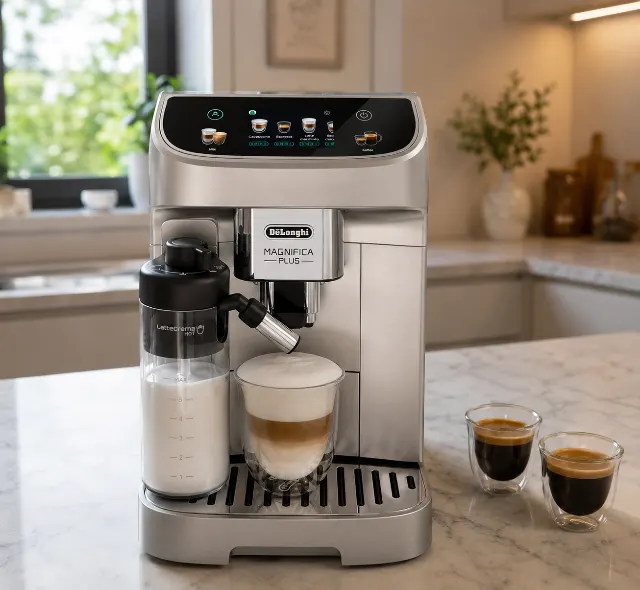
De'Longhi Magnifica Plus Fully Automatic Espresso
The De'Longhi Magnifica Plus delivers an impressive array of one-touch milk drinks with its reliable LatteCrema system, but its plastic-heavy build and noisy operation are notable tradeoffs for the convenience.
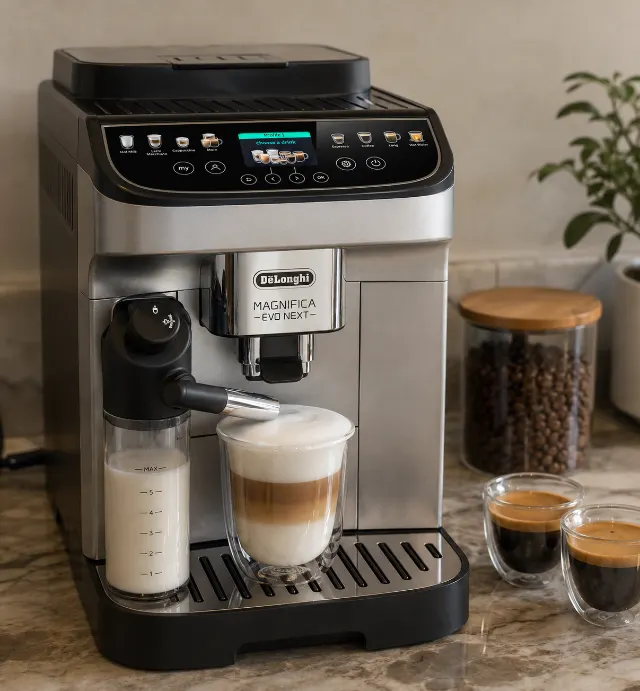
De'Longhi Magnifica Evo Next Fully Automatic Espresso
A deep dive into the De'Longhi Magnifica Evo Next's long-term value, analyzing its one-touch iced coffee feature against its significant maintenance demands.
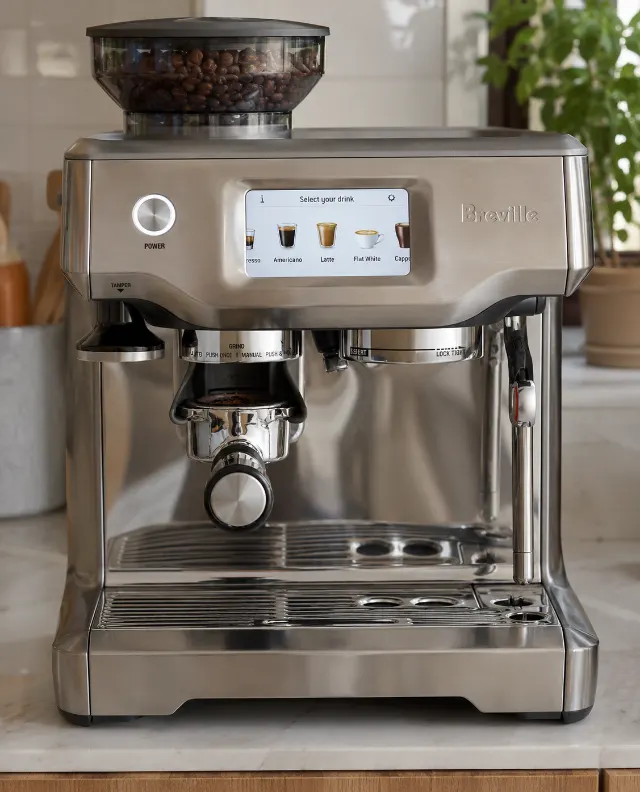
Breville Barista Touch Espresso Machine BES880BSS
The Breville Barista Touch BES880BSS excels at guided, consistent espresso for beginners, but its integrated grinder and single boiler system present real limitations for enthusiasts.