Breville Barista Touch Espresso Machine BES880BSS Review
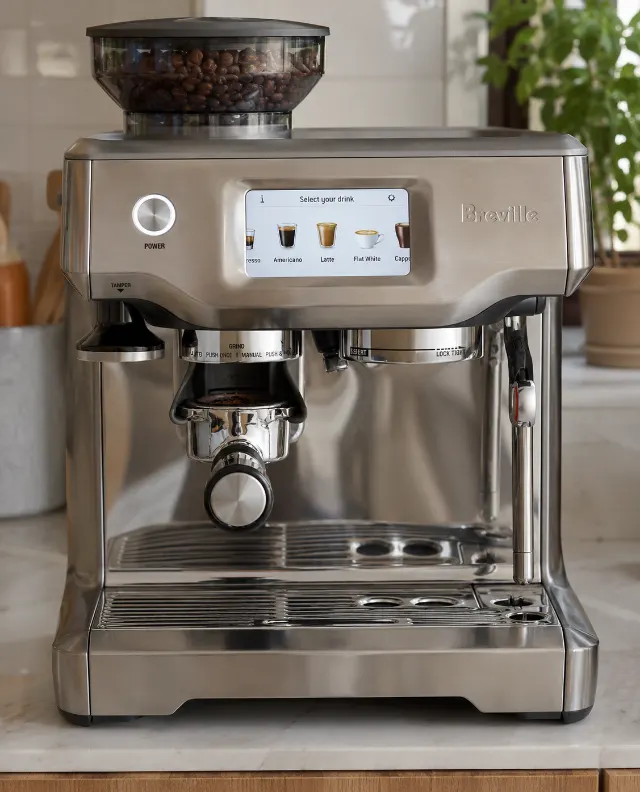
The scorecard
- Value
- ★★★★★ ★★★★★ 3.9
- Quality
- ★★★★★ ★★★★★ 4.1
- Ease of use
- ★★★★★ ★★★★★ 4.6
- Durability
- ★★★★★ ★★★★★ 4.0
Where it wins
- ✓ThermoJet heating system is ready in 3 seconds, eliminating the long wait of traditional boiler machines.
- ✓Color touchscreen provides guided recipes and allows saving up to 8 personalized drinks.
- ✓Automatic steam wand consistently produces fine-celled microfoam with adjustable temperature and texture.
- ✓Integrated conical burr grinder with 30 settings offers decent range for dialing in espresso.
- ✓Low-pressure pre-infusion followed by 9-bar extraction produces balanced shots with good crema.
Drawbacks
- ✕Integrated grinder clogs easily with oily, dark-roast beans, requiring frequent and involved cleaning.
- ✕Single ThermoJet system prevents simultaneous brewing and steaming, slowing workflow for multiple drinks.
- ✕54mm portafilter is less forgiving of puck prep inconsistencies than the 58mm industry standard.
- ✕Internal plastic components, particularly the solenoid housing, are known failure points after 3-5 years.
What this is, in plain terms
This is a guided semi-automatic espresso machine. It combines a built-in conical burr grinder, a rapid-heating ThermoJet system, and a touchscreen interface that walks you through making drinks. It is optimized for speed and repeatability. The target buyer wants a latte that tastes like one from a good cafe, wants it in under three minutes from a cold start, and does not want to read a 30-page manual on milk steaming theory to get it. Its defining feature is the automatic steam wand, which heats milk to a set temperature and texture with no manual intervention. Breville’s marketing frames this as a “barista-quality” experience. This is the review's first point of disagreement. While the machine can produce excellent espresso with its digital PID temperature control ensuring thermal stability, the 54mm portafilter and integrated grinder are a step below the 58mm standard and separate, high-performance grinders used in specialty coffee. It produces high-quality *home* espresso, a meaningful distinction. You get 80% of the quality for 20% of the effort, which is precisely the point.Barista Touch vs. Barista Pro: Which is Right for You?
The choice between the Breville Barista Touch and the Barista Pro boils down to interface and automation. The Barista Touch, with its color touchscreen and pre-programmed drinks, is for the user who values convenience. Its automatic milk frothing is its killer feature. The Barista Pro uses a simpler LCD screen with button controls and has a traditional manual steam wand. It's for the aspiring barista who wants to learn the craft of milk texturing and prefers tactile control over automation. The Pro is slightly faster at steaming due to its more powerful thermocoil, but the Touch is more consistent for a beginner.Barista Touch vs. Barista Touch Impress: Key Differences
The Breville Barista Touch Impress is the newer sibling, and it adds an intelligent dosing and assisted tamping system. The Impress model calculates the coffee dose based on the last shot and uses a side lever to deliver a consistent 10kg tamp. This solves two major variables for beginners: how much coffee to use and how hard to press it. The standard Barista Touch requires you to dose and tamp manually. If your main goal is eliminating mess and guesswork, the Impress is the better machine. If you don't mind a small learning curve with a separate tamper, the standard Touch offers a more classic workflow at a lower cost.The build, up close
Build Quality: ★★★★☆ (4.1/5)
Brushed stainless steel makes up the main housing, giving it a premium look that fits its price. The portafilter is solid and has a good heft. However, the drip tray cover is thin, and the water tank is a fairly standard plastic. What most reviews miss is the extensive use of plastic in the internal chassis and tubing. While this is common at this price point, long-term owner feedback shows the plastic solenoid housing can become brittle and crack after 4-5 years of heat cycles, leading to leaks. It's a solid machine, but it's not built like a commercial unit meant to last decades.Long-term Reliability: ★★★★☆ (4.0/5)
With proper maintenance, a Breville Barista Touch can last 5 to 10 years. The most common failure points are the three-way solenoid valve and the water pump, typically after the 3-5 year mark. The built-in grinder is another area of concern; using very oily, dark-roast beans is a known cause of clogs that can burn out the motor if not cleared. The warranty is typically one or two years depending on the region, which feels short for a machine at this price. Remanufactured Breville Barista Touch units often come with a 6-month warranty, a significant risk for a modest discount.How it performs day to day
The ThermoJet heating system is the star. A 3-second heat-up time is not an exaggeration; the machine is ready to pull a shot before you’ve finished grinding the beans. This is a massive quality-of-life improvement over traditional boiler machines that can take 15-20 minutes. Shot quality, once dialed in, is excellent. The combination of low-pressure pre-infusion and a final 9-bar extraction, regulated by an over-pressure valve (OPV), produces balanced, flavorful espresso that far surpasses any pod system or cheaper appliance. Dialing in a new bag of beans is straightforward thanks to the touchscreen. You can adjust grind size on the side dial (30 steps) and grind time on the screen in 0.5-second increments. The automatic milk frothing is surprisingly effective, creating fine-celled microfoam suitable for basic latte art. You can save up to 8 custom drinks, programming your preferred grind time, shot volume, and milk temperature/texture. This level of customization makes the morning routine incredibly efficient. For its intended purpose—fast, consistent, high-quality milk drinks—it performs exceptionally well.Buy this if you live in a household with multiple coffee drinkers who have different preferences, and your primary goal is to replicate your favorite cafe's latte or cappuccino with minimal morning friction. It's the right choice over the more manual Breville Barista Express Espresso if your budget allows for the significant convenience upgrade.
Honest drawbacks
The biggest limitation is the integrated grinder. While convenient, it lacks the fine-grained control and consistency of a good standalone grinder. It struggles with very light or very dark roasts, and owners consistently report that oily beans will clog the burrs, requiring a full disassembly to clean. This is the machine's Achilles' heel. The second major issue is the single heating system (ThermoJet). You cannot pull a shot and steam milk simultaneously. While the transition is fast, it slows down the workflow when making multiple drinks compared to a dual boiler machine like the Breville Dual Boiler or even some high-end heat exchangers. The 54mm portafilter is another constraint. It's more sensitive to puck prep than the commercial-standard 58mm size, making channeling more likely if your distribution is sloppy. Finally, the reliance on the touchscreen is a double-edged sword. If the screen fails outside of warranty, the machine becomes an expensive paperweight, a risk not present in machines with analog controls.Skip this if you see espresso as a hobby you want to grow into. The integrated systems that make it great for beginners will become the limitations you resent. You'd be better served by pairing a more basic machine like a Gaggia Classic Pro with a separate, high-quality grinder, which offers a higher performance ceiling for a similar total cost of ownership.
Using it for real
Your first week is all about the screen. You follow the prompts, marvel at the automatic milk, and save your first custom drink. It feels foolproof. By week three, the routine solidifies. You find the grind setting that works for your favorite beans (typically between 8-14 for espresso) and rarely touch it again. You stop using the pre-programmed 'Latte' or 'Cappuccino' settings and just use your custom 'My Coffee' setting every time. The machine effectively becomes a one-touch appliance for your specific drink. Owners discover after a few months that the automatic milk frothing, while good, has its limits. The texture is consistent but often a little too airy for detailed latte art. Many who get serious about the craft find themselves wishing for the manual control of the Barista Pro's wand. The feature that is most often ignored after the novelty wears off is the sheer number of drink options; most users settle on one or two custom profiles and never touch the others again. What owners wish they knew is how critical cleaning is. The machine will prompt you for a cleaning cycle every 200 shots, and ignoring it leads to a noticeable drop in performance and, eventually, low pressure issues. The descaling process, required every few months depending on water hardness, is a 20-minute affair that cannot be skipped.What the years look like
This is not a set-it-and-forget-it appliance. A daily backflush with plain water takes 20 seconds and is non-negotiable for shot quality. A full cleaning cycle with a tablet is needed every month or two for moderate users. Descaling is prompted by the machine based on water hardness settings and usage, typically every 3-6 months. The hidden cost is in these consumables: water filters (replace every 3 months) and cleaning tablets. While not exorbitant, it's a recurring expense not present with simpler machines. Beyond the spec sheet, the first part to show wear is often the group head gasket, a silicone ring that creates the seal with the portafilter. It's a cheap part and easy to replace, but expect to do so every 12-18 months. The grinder burrs will dull after about 500 pounds of coffee, which for most home users is many years, but it's not a 'lifetime' component. The realistic lifespan of the machine, with diligent care, is in the 5-8 year range before a more significant repair (like a pump or solenoid) is likely needed. This is respectable for a complex appliance but falls short of the multi-decade lifespan of simpler, more robust Italian machines.How it stacks up to rivals
Against its direct competitors, the Barista Touch holds its own by focusing on the user interface. The De'Longhi La Specialista Maestro Espresso offers a more hands-on approach with its smart tamping station and separate milk frothing pitcher, appealing to those who want more control without full manual operation. However, its dual heating system allows for simultaneous brewing and steaming, a clear advantage for those making multiple milk drinks back-to-back. An overlooked competitor is a combination like the Breville Bambino Plus paired with a separate Baratza Encore ESP grinder. This setup costs roughly the same, but offers a modular path for upgrades. The Bambino Plus has the same automatic steam wand and 3-second heat-up time, but if you decide the grinder is holding you back, you can upgrade it without replacing the entire machine. This is the smarter long-term investment for an aspiring hobbyist. Compared to a super-automatic machine like the De'Longhi Magnifica Evo Automatic Espresso & Coffee Machine, the Barista Touch provides a far more authentic espresso experience and better milk texture. The Magnifica is a true bean-to-cup machine that does everything with one button press, but sacrifices shot quality and control. The Barista Touch is the middle ground between full manual control and push-button convenience.Is it for you?
Best for: The household that wants to upgrade from a pod machine to high-quality espresso and milk drinks without a steep learning curve or manual effort. Its speed and consistency are perfect for busy mornings. Not ideal for: The aspiring coffee hobbyist who wants to experiment with different grinders, puck preparation techniques, and manual latte art. The all-in-one design will eventually feel restrictive. This machine's value is directly tied to how much you value convenience. It automates the most difficult parts of the espresso workflow and does so reliably. If the idea of weighing beans, timing shots, and practicing milk steaming sounds like a chore rather than a hobby, the price premium for the touchscreen and automatic wand is justified. It produces drinks that are significantly better than any super-automatic in its price class, without demanding the skill of a fully manual setup.Our verdict
The Breville Barista Touch BES880BSS successfully delivers on its promise of guided, convenient, cafe-quality drinks at home. Its ThermoJet heater is a genuine improvement to the morning workflow, and the touchscreen interface effectively demystifies the process for beginners. The primary caveat remains its integrated nature; you are buying into a closed system that performs well but offers no path for piecemeal upgrades. **For the person who wants a great latte at 8 AM without becoming a coffee nerd, this is an excellent choice.**The standout detail
The automatic steam wand's temperature sensor is on the drip tray, not the wand itself. This means pitcher placement is critical; if it's off-center, milk temperature can vary by 10°F shot to shot.
Specifications
| Type | Guided Semi-Automatic |
|---|---|
| Boiler system | ThermoJet Heating System |
| Portafilter size | 54mm |
| Pump pressure | 15 Bar Italian Pump (9 Bar at group head) |
| Steam wand | Automatic with adjustable temperature/texture |
| Built-in grinder | Integrated steel conical burr |
| Water tank | 67 oz (2L) |
| Heat-up time | 3 seconds |
| Warranty | 2-Year Limited Product Warranty (US/Canada) |
How it compares
Versus the alternatives buyers cross-shop — judged on ownership, not just spec sheets.
| Alternative | Ease of use | Maintenance | Durability | Value | Best for |
|---|---|---|---|---|---|
| Breville Barista Touch BES880BSS (this pick) | Touchscreen guidance and automatic milk steaming make it the easiest to learn. | Requires frequent, prompted cleaning cycles with tablets and regular descaling. | Brushed steel exterior with internal plastic parts that can fail after 3-5 years. | Premium price for convenience; integrated design limits long-term upgradeability. | Beginners in a busy household prioritizing speed and consistency over manual control. |
| Breville Barista Express Espresso | Steeper learning curve with manual pressure gauge, dosing, and milk steaming. | Similar cleaning and descaling regimen, but fewer electronic failure points. | Slightly more robust due to simpler mechanics and fewer electronics. | Lower entry cost, but requires more skill to achieve consistent results. | Aspiring hobbyists on a budget who want to learn the fundamentals of espresso making. |
| De'Longhi La Specialista Maestro Espresso | Assisted tamping and dual heating system offer a different kind of convenience. | Slightly more complex cleaning due to the tamping station mechanism. | Comparable build quality with a mix of metal and plastic components. | Higher price for dual heaters, which is justified for those making multiple milk drinks. | The user who wants to make multiple lattes quickly and values simultaneous operation. |
| De'Longhi Magnifica Evo Automatic Espresso & Coffee Machine | Fully automatic (super-automatic); one-touch operation for various drinks. | Requires regular cleaning of the internal brew group, which can be messy. | Complex internal mechanics can be prone to issues if not meticulously maintained. | Offers total convenience but at a significant cost to espresso quality and texture. | Someone who wants zero involvement in the coffee-making process and values speed above all. |
How it scores on what matters
| Product | Espresso shot quality | Milk steaming & microfoam | Consistency shot-to-shot | Ease of dialing in | Heat-up & workflow speed | Maintenance burden | Verdict |
|---|---|---|---|---|---|---|---|
| Breville Barista Touch BES880BSS (this pick) | Very good | Excellent | Very good | Excellent | Excellent | Fair | Top-tier convenience and speed, held back by maintenance needs. |
| Breville Barista Express Espresso | Very good | Good | Fair | Fair | Good | Good | Capable machine that demands significant user skill to master. |
| De'Longhi La Specialista Maestro Espresso | Very good | Very good | Very good | Very good | Excellent | Fair | Excellent workflow for milk drinks, but more complex. |
| De'Longhi Magnifica Evo Automatic Espresso & Coffee Machine | Fair | Good | Excellent | Excellent | Very good | Fair | Unbeatable ease, but espresso quality is a clear compromise. |
Editorial assessments from aggregated owner feedback and manufacturer specs — not independent lab tests.
Who gets the most from it
Ideal for the busy professional or couple wanting cafe-style drinks with minimal fuss in a kitchen with standard 18-inch cabinet clearance. Skip this if you are a dedicated hobbyist who wants to experiment with different grinders or prefers the tactile feedback of manual steaming.
What makes it worth it
This machine solves the intimidation factor of traditional espresso. Its touchscreen guides you, while competitors like the <a href="/espresso-machines/breville-barista-express-espresso/">Breville Barista Express Espresso</a> demand a steeper learning curve. It automates the trickiest part—milk frothing—delivering consistency that manual wands take months to master.
Frequently asked questions
Is the Breville Barista Touch worth it in 2026?
For those prioritizing convenience and consistent results without a steep learning curve, yes. Its 3-second heat-up time and automatic milk frothing justify the premium over more manual machines, making it ideal for busy users who want great drinks with minimal effort.
What is the difference between the Breville Barista Touch and Barista Pro?
The key distinction is the interface. The Barista Touch uses a color touchscreen with pre-programmed drinks and features an automatic steam wand. In contrast, the Barista Pro has a simpler LCD with buttons and requires manual milk frothing, offering more hands-on control.
What are the common problems with Breville espresso machines?
Recurring issues across the line include grinder blockages from oily beans, inconsistent pressure due to internal scale buildup, and solenoid or pump failures after several years. Using fresh, medium-roast beans and performing regular descaling cycles can prevent most of these problems.
Which Breville espresso machine is the best?
Defining the 'best' depends entirely on your priorities. The Barista Touch excels in convenience and guided automation. The Barista Pro is superior for those wanting manual control to learn latte art. For ultimate performance, the Oracle Touch offers dual boilers and automated tamping.
What is the difference between the Barista Touch and the Barista Touch Impress?
Adding an 'intelligent' dosing and assisted tamping system is the Impress model's main upgrade. It uses sensors to calculate the correct coffee dose and a side lever for a perfect 10kg tamp, which significantly reduces the mess and guesswork of the standard Barista Touch.
How long does a Breville Barista Touch last?
With diligent care, including frequent cleaning and descaling, a Barista Touch can last from 5 to 10 years. Its lifespan is highly dependent on maintenance, as key components like the pump and solenoid may need servicing or replacement over time, especially with heavy use.
Can you use oily beans in the Breville Barista Touch?
While technically possible, it is strongly discouraged. Oily, dark-roast beans are the leading cause of clogs in the integrated grinder. Long-term owner feedback confirms that sticking to fresh, medium-roast beans is critical to prevent jams and potential motor damage.
People also ask
- Is the Breville Barista Touch worth it?
- What is the difference between Breville Barista Touch and Barista Pro?
- What are the common problems with Breville machines?
- Which Breville espresso machine is best?
- Can you make regular coffee with the Breville Barista Touch?
- Can I use oily beans in the Breville Barista Touch?
- What is the difference between the Breville Barista Touch and the Impress?
- Which Breville espresso machine is best for beginners?
- How long does the Breville Barista Touch typically last?
You might also like
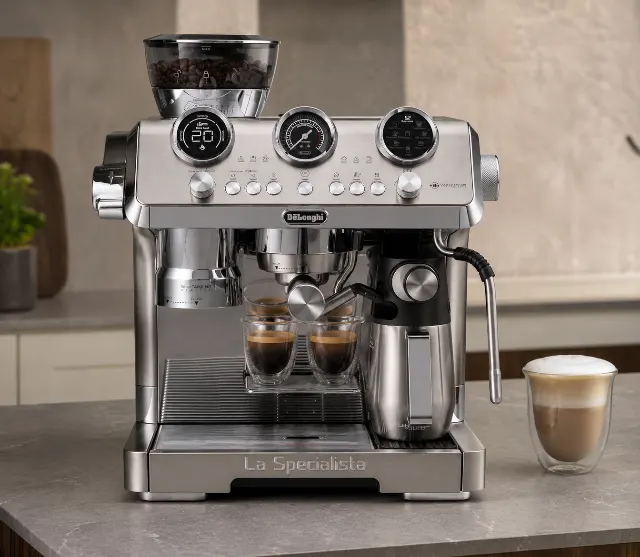
De'Longhi La Specialista Maestro Espresso
The De'Longhi La Specialista Maestro excels at convenient, repeatable espresso with a built-in tamper, but its grinder and plastic components betray its premium price point for purists.
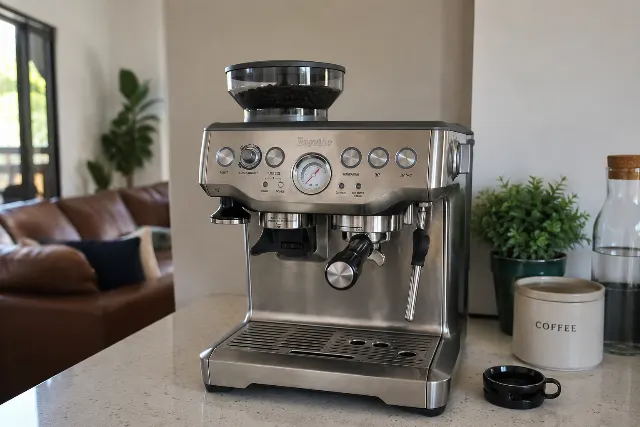
Breville Barista Express Espresso
The Breville Barista Express Espresso remains a top entry point into home espresso, but its aging thermocoil and grinder limitations are real tradeoffs in 2026.
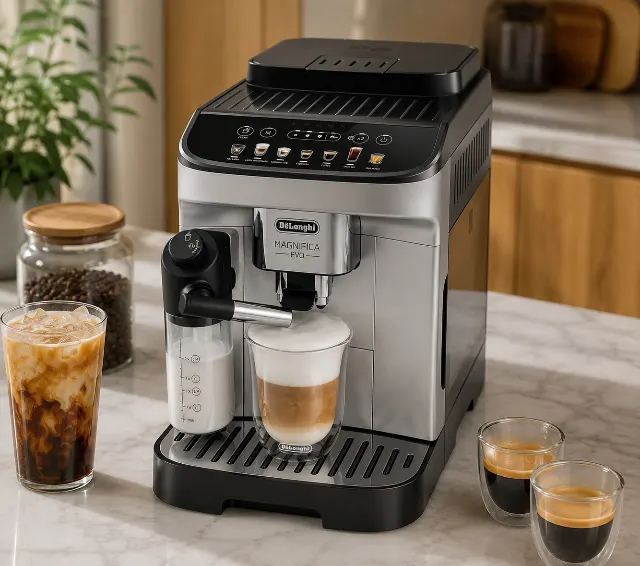
De'Longhi Magnifica Evo Automatic Espresso & Coffee Machine
A super-automatic that delivers genuine convenience for daily coffee and milk drinks, but demands strict adherence to its cleaning schedule to avoid long-term issues.
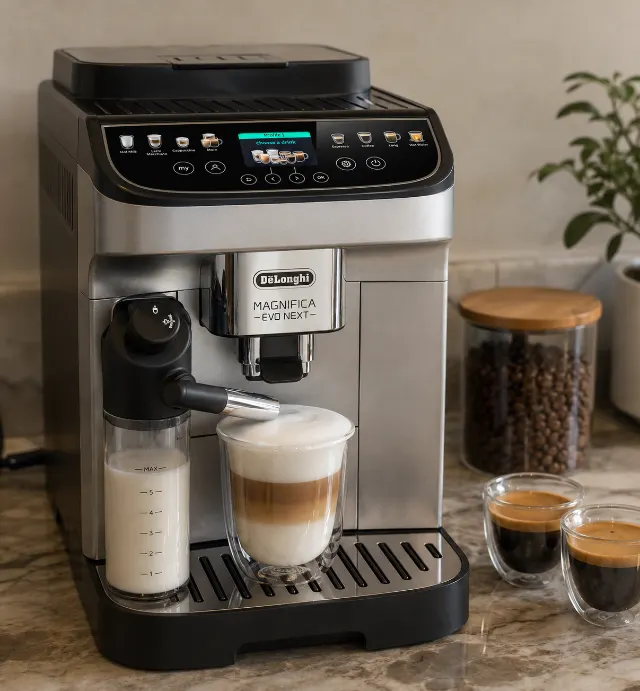
De'Longhi Magnifica Evo Next Fully Automatic Espresso
A deep dive into the De'Longhi Magnifica Evo Next's long-term value, analyzing its one-touch iced coffee feature against its significant maintenance demands.