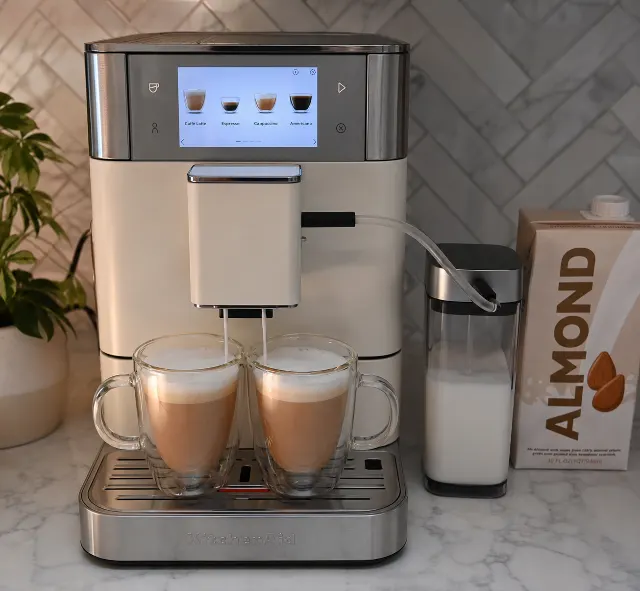
KitchenAid Fully Automatic Espresso Machine KF8, KES8558PL, Porcelain White Review
What sets it apart
THE X-FACTOR: The machine's automatic cleaning cycles use a surprising amount of water, often requiring a water tank refill every 3-4 drinks, a detail absent from marketing materials and a frequent owner complaint.
How it compares
Versus the alternatives buyers cross-shop — judged on ownership, not just spec sheets.
| Alternative | Ease of use | Maintenance | Durability | Value | Best for |
|---|---|---|---|---|---|
| KitchenAid Fully Automatic Espresso Machine KF8, KES8558PL, Porcelain White (this pick) | Excellent; guided by a large color touchscreen with 40+ pre-programmed recipes. | High; frequent, automated cleaning cycles consume lots of water. Non-removable brew group. | Very good external build with die-cast metal; internal plastic brew group is a potential long-term failure point. | Good; premium price for design and features, but ongoing consumable costs are a factor. | The design-focused user who wants maximum drink variety and a statement appliance for their kitchen. |
| Jura ENA 8 | Very good; simple interface but fewer one-touch options than the KF8. | High; also uses automated cleaning cycles with proprietary tablets. Non-removable brew group. | Very good; known for reliable internals, though the housing is mostly high-quality plastic. | Good; a premium price for superior espresso extraction technology (P.E.P.). | The espresso purist who values the quality of the straight shot over a vast milk drink menu. |
| De'Longhi Dinamica Plus | Excellent; intuitive touchscreen and app connectivity for customization. | Moderate; features a removable brew group, allowing for easy manual rinsing and maintenance. | Good; mostly plastic construction feels less premium but is proven to be reliable. | Excellent; often priced lower than the KF8 while offering more grinder settings and a removable brew unit. | The pragmatic buyer seeking the best performance-per-dollar and easier long-term maintenance. |
| KitchenAid Fully Automatic Espresso Machine KF7 with Milk Attachment | Good; button-based interface is less intuitive than the KF8's touchscreen. | High; similar automated cleaning system and non-removable brew group. | Very good; shares a similar robust metal-forward build with the KF8. | Fair; often not discounted enough to justify choosing it over the much-improved KF8. | Buyers who find it on a deep clearance sale and only need basic café drinks. |
How it scores on what matters
| Product | Espresso shot quality | Milk steaming & microfoam | Consistency shot-to-shot | Ease of dialing in | Heat-up & workflow speed | Maintenance burden | Verdict |
|---|---|---|---|---|---|---|---|
| KitchenAid Fully Automatic Espresso Machine KF8, KES8558PL, Porcelain White (this pick) | Good | Excellent | Excellent | Fair | Very good | Fair | Top-tier for milk drinks, but limited grinder holds it back. |
| Jura ENA 8 | Excellent | Very good | Excellent | Fair | Very good | Fair | The best espresso shot in its class; milk is secondary. |
| De'Longhi Dinamica Plus | Very good | Very good | Very good | Good | Excellent | Good | The pragmatic all-rounder with the easiest maintenance. |
| KitchenAid Fully Automatic Espresso Machine KF7 with Milk Attachment | Good | Good | Very good | Weak | Good | Fair | Dated interface and fewer features make it a tough sell. |
Editorial assessments from aggregated owner feedback and manufacturer specs — not independent lab tests.
Where the scores land
- Value
- ★★★★★ ★★★★★ 4.0
- Quality
- ★★★★★ ★★★★★ 4.5
- Ease of use
- ★★★★★ ★★★★★ 4.7
- Durability
- ★★★★★ ★★★★★ 3.9
What we like
- ✓Superior die-cast metal construction provides a premium feel and durability unmatched by plastic competitors.
- ✓Extensive library of over 40 one-touch drink recipes, from flat whites to macchiatos, is among the largest in its class.
- ✓Excellent automated milk frothing system produces fine-textured microfoam suitable for basic latte art.
- ✓Fast thermoblock heating system is ready to brew in under 45 seconds from a cold start.
- ✓Intuitive, high-resolution color touchscreen makes navigating options straightforward despite the menu depth.
Where it falls short
- ✕Integrated burr grinder is significantly louder than competitors from Jura or Miele.
- ✕Frequent, high-volume automatic cleaning cycles mean the 2.2L water tank requires near-daily refilling.
- ✕The 5-step grinder adjustment is limited for dialing in specialty or light-roast coffee beans.
- ✕Non-removable brew group prevents manual cleaning and lubrication, relying solely on cleaning tablets.
What you're really getting
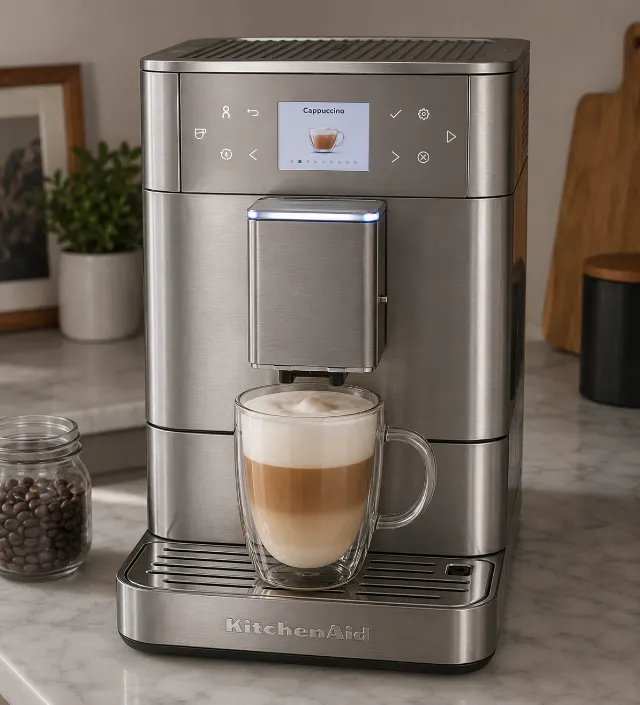
This is a one-touch milk drink appliance first and an espresso machine second. Its defining feature is the library of over 40 recipes, from a flat white to a latte macchiato, all executed automatically via the vibrant touchscreen. The internal thermoblock heating system ensures a rapid heat-up time, typically under 45 seconds, making it genuinely useful on a busy morning. KitchenAid's marketing emphasizes the stainless steel burr grinder and robust metal housing. While the build is indeed a significant step up from the plastic-heavy construction of many rivals, the grinder itself is a point of contention. The spec sheet implies precision, but what owners report is closer to functional adequacy. It has only five main adjustment settings, a stark contrast to the 13 on a De'Longhi Dinamica Plus or the near-infinite steps on a separate grinder. This limits how well you can truly dial in a specific bean. For medium roast, pre-blended espresso beans, it works well. For light roast single-origins, it struggles to grind fine enough for a proper extraction without choking. Here is where we must disagree with the common narrative: the KF8 is not a direct replacement for a semi-automatic setup for the enthusiast. It is an appliance for achieving 85% of the quality with 10% of the effort. The promise of café-quality espresso is moderated by the grinder's limitations and the automated, non-adjustable pre-infusion cycle. It produces a very good, consistent shot, but not a god shot.KitchenAid KF8 vs. Older Models: KF7 & KF6 Compared
The jump from the KitchenAid Fully Automatic Espresso Machine KF7 with Milk Attachment to the KF8 is substantial, primarily in software and user interface. The KF7 offered around 15 recipes; the KF8 more than doubles that to 40+. The KF8's color touchscreen is more responsive and intuitive than the button-and-dial interface of the KF7. While the core brewing mechanics and thermoblock are similar, the user experience is leagues apart. The upgrade is worth the investment if drink variety is your primary motivation. Comparing the KF8 to the much older KitchenAid Fully Automatic Espresso Machine KF6 is like comparing a smartphone to a feature phone. The KF6 was a more basic machine with limited customization. The KF8 introduces user profiles, a far more sophisticated milk system, and the expansive recipe book. There is no reason to consider a KF6 in 2026 unless found at a steep discount for basic functions only.Construction and longevity
Build Quality: ★★★★☆ (4.5/5)
The machine's housing is its strongest asset. The die-cast metal front panel and heavy-duty construction give it a presence on the counter that plastic competitors lack. It feels substantial and well-assembled. Dials and buttons have a positive, tactile click. The drip tray cover is metal, not chrome-plated plastic, which resists scratching far better over time. The only demerits are for the plastic water tank and bean hopper lid, which feel incongruous with the rest of the premium build.Long-term Reliability: ★★★☆☆ (3.9/5)
While the external build is robust, long-term owner feedback shows a few recurring internal issues. The most common point of failure after 2-3 years is the gearing mechanism within the brew group. It's a plastic component under significant stress, and a known weak point across many super-automatic brands, not just KitchenAid. The automatic milk frother, if not cleaned daily with religious diligence, is prone to clogging that can be difficult to clear. The warranty is typically one year, which feels short for a premium-priced appliance. The cost of an out-of-warranty brew group repair can be a significant percentage of the machine's original purchase price.Overlooked detail: The brew group is not user-serviceable
What most reviews miss is that unlike many De'Longhi or Saeco machines, the KF8's brew group is not designed to be easily removed by the user for manual cleaning. It relies entirely on its internal tablet-based cleaning cycles. While convenient, this means you cannot manually rinse or lubricate the mechanism, placing a huge amount of trust in the automated system. For owners who prefer hands-on maintenance, this is a significant drawback.How it performs day to day
It excels at speed and simplicity. From a cold start, you can have a cappuccino in hand in under two minutes. The on-screen prompts guide you through every step, from adding beans to positioning the milk carafe. The quality of the automated microfoam is genuinely good, creating a texture suitable for basic latte art, a feat many super-automatics fail to achieve. The machine consistently hits a stable brew temperature thanks to its PID-controlled thermoblock, producing shots that are never sour or bitter due to temperature swings. The integrated grinder is loud. There is no way to soften this. It's a high-pitched, mechanical sound that will be heard throughout a quiet home. Verified buyers note it's noticeably louder than the grinders in Jura's ENA line or Miele's countertop units. This is perhaps the single biggest daily annoyance and the reason many early-morning coffee drinkers might hesitate. Another point of daily interaction is the drip tray. Because of the frequent rinse cycles, it fills up quickly, often needing to be emptied every 4-6 drinks. It's a minor task, but one that feels more frequent than on competing machines. The machine is also large. With dimensions of approximately 33 cm wide by 45 cm deep by 40 cm high (13 x 17.7 x 15.7 inches), checking your under-cabinet clearance is not a suggestion; it's a requirement. Buy this if you value countertop aesthetics and a deep menu of one-touch milk drinks above all else. If your kitchen is the heart of your home and you entertain often, the KF8's combination of style, speed, and variety is a winning formula that justifies its premium positioning over a more plasticky but functional De'Longhi.The annoyances
Beyond the grinder noise and water consumption, the menu system can be frustrating. While beautiful, navigating through 40+ drinks to find your favorite can be tedious. The user profiles help, but the initial setup and customization have a definite learning curve. Reddit threads on this product surface a pattern of users simply defaulting to the first few drinks on the menu rather than exploring the machine's full capability. Another recurring complaint in owner reviews is the machine's performance with very oily coffee beans. The grinder mechanism can struggle, and the oils tend to build up in the brew group, requiring more frequent cleaning cycles with degreasing tablets. Sticking to medium-roast, low-oil beans is the key to consistent performance, which limits your coffee exploration. This is a common issue with super-automatics, but it seems particularly pronounced with the KF8's grinder design. Lastly, the automatic cleaning cycles, while thorough, are slow. The milk system cleaning takes several minutes and cannot be skipped. If you're in a rush, this forced waiting period can be irritating. The machine dictates the workflow, and the user has little choice but to follow its lead. Skip this if you are sensitive to noise or primarily drink black coffee and espresso. The premium you pay for the KF8 is for its advanced milk system and design. If those aren't your priorities, a machine like the Jura ENA 4 (espresso only) or even a high-end pod system will deliver your coffee with less noise, a smaller footprint, and a lower maintenance burden for a comparable or lower cost of entry.Using it for real
The first week is about exploration, trying every exotic drink on the menu. By week three, most owners settle into a routine with two or three favorites saved to a profile. The feature you thought you'd use daily—like the custom strength adjustment for each drink—often gets set once and then forgotten. The machine's defaults are generally well-calibrated. What owners wish they'd known is the true cost of ownership. It's not just the purchase price. The machine requires specific cleaning tablets, descaling solution, and water filters. Using third-party consumables can void the warranty. These costs, while not exorbitant, add up over the life of the machine and are a factor to consider against a simpler semi-automatic machine where the only consumable is coffee. One thing that rarely gets used is the hot water dispenser function. While present, its temperature is optimized for rinsing, not for tea. Most users report it's not quite hot enough for a proper cup of black tea and they default back to a kettle. It's a feature that exists on the spec sheet but has little practical utility.Long-term ownership
Plan for a strict maintenance schedule. The milk carafe needs a daily rinse, and the full auto-clean cycle should be run every day it's used. The drip tray and grounds container will need emptying every other day in a typical two-person household. A full descaling cycle will be prompted by the machine every 2-4 months, depending on your water hardness setting. This is a 20-minute, non-skippable process. Forum discussions point to the water filter as the first consumable to need replacement, typically every 2 months. The brew group cleaning tablets are used less frequently, perhaps every 3-4 months. The hidden cost is the sheer volume of water used. If you live in an area with high water costs, the constant flushing cycles are a non-trivial factor in the long-term cost of ownership. Realistically, the lifespan of a heavily used super-automatic like the KF8, even with perfect maintenance, is about 5-7 years before a major component like the grinder or brew group requires a costly repair. This is a significant departure from a well-made semi-automatic machine, which can last for decades with simple part replacements. The convenience of automation comes at the price of a shorter, more finite operational life.How it compares to the field
The most direct competitor is the Jura ENA 8. The KitchenAid KF8 vs Jura ENA 8 comparison is a battle of philosophies. The Jura focuses on perfecting the espresso shot with its Pulse Extraction Process (P.E.P.), which optimizes extraction time for short coffees. The KF8 focuses on a wider drink library and a more robust, metal-clad design. For latte art and milk drink variety, the KF8 has a slight edge; for the quality of a single espresso, the Jura is arguably superior. The choice is aesthetics and variety (KitchenAid) versus espresso purism (Jura). Against the De'Longhi Dinamica Plus, the KF8 wins on build quality and design, hands down. The Dinamica Plus, however, offers a more adjustable grinder (13 steps vs. 5), a removable brew group for easier cleaning, and often comes in at a more accessible price point. It's the pragmatic choice, while the KF8 is the emotional, design-led one. An overlooked competitor is the Miele CM 5310 Silence. As the name implies, its grinder is significantly quieter than the KF8's, a massive quality-of-life improvement. While its drink menu isn't as expansive, it covers all the core café favorites and Miele has a stellar reputation for long-term reliability. It lacks the iconic KitchenAid styling but is a formidable opponent on pure performance and livability. For those looking for a simpler experience, the more basic KitchenAid Fully Automatic Espresso Machine KF2 with 6 Hot and Iced Coffee and KitchenAid Fully Automatic Espresso Machine KF3 with 15+ Hot and Iced Coffee Options offer a similar design language with fewer features for a lower cost of entry, but they lack the premium feel and advanced milk system of the flagship KF8.Head-to-Head: KitchenAid KF8 vs. Jura
When it comes to pure espresso quality, Jura's P.E.P. (Pulse Extraction Process) technology gives it an edge for short coffees like ristretto and espresso, creating a richer crema and more nuanced flavor profile. However, for milk-based drinks, the difference is negligible. The KF8 produces excellent microfoam and its automated system is arguably easier to clean than some Jura models. The KF8's larger, more vibrant color screen is more user-friendly than the smaller screen or button interfaces on comparable Jura models like the ENA 8. Ultimately, if you drink 80% lattes and cappuccinos, the KF8 is a strong contender. If you are an espresso purist, the Jura is likely the better fit.Is it for you?
Best for: Design-conscious households that prioritize one-touch convenience and a wide variety of milk-based drinks. If your kitchen features other KitchenAid appliances and you want a machine that makes a statement while delivering consistent lattes and cappuccinos with zero fuss, the KF8 is built for you. Not ideal for: Espresso purists, light sleepers in small apartments, or anyone who enjoys the ritual and control of manual coffee making. The limited grinder settings, loud operation, and locked-down maintenance routine will be constant sources of frustration for the hands-on hobbyist. The KitchenAid KF8 is worth the money in 2026 if, and only if, its specific strengths align with your daily needs. It commands a premium price for its design, build quality, and extensive recipe book. If you will genuinely use the variety of drinks and value the machine as a piece of functional kitchen art, the investment makes sense. If you just want a good, quick espresso, your money is better spent elsewhere.Final judgement
The KitchenAid KF8 is a beautifully crafted and ambitious super-automatic machine that successfully brings one-touch café variety into the home. It delivers on its promise of high-quality milk drinks and effortless operation, wrapped in a design that embarrasses its plastic-bodied competitors. However, its excellence in these areas is paid for with a loud grinder and a demanding, water-hungry cleaning regimen that complicates the dream of simple, elegant coffee. This is the super-automatic for the style-conscious latte drinker; espresso purists should look to Jura.Specifications
| Type | Super-automatic |
|---|---|
| Boiler system | Thermoblock |
| Pump pressure | 15 Bar (delivers ~9-bar at the group head) |
| Steam wand | Automatic milk carafe system |
| Built-in grinder | Stainless steel conical burr with 5 settings |
| Water tank | 2.2 Liters (74 oz) |
| Heat-up time | Under 45 seconds |
| Warranty | 1-Year Limited Warranty (US & Canada) |
Who this suits
Ideal for the design-conscious user who prioritizes a wide menu of automated milk-based drinks and values a premium metal build over whisper-quiet operation. Skip this if you live in a small apartment where grinder noise is a major issue or if you primarily drink straight espresso; a Jura ENA 8 offers a more refined espresso shot for a similar investment.
Why buy it
The KitchenAid KF8 solves the problem of wanting a vast, café-style drink menu without a complex user interface. Where a De'Longhi Dinamica Plus feels utilitarian, the KF8 feels like a statement piece. It delivers on the promise of a one-touch cappuccino that looks and tastes the part, something many mid-range super-automatics struggle to perfect.
Frequently asked questions
Is the KitchenAid KF8 espresso machine any good?
Yes, it is a very good machine for its target user, excelling at one-touch milk drinks and offering a premium metal build. Its main strengths are the 40+ recipe options and ease of use, though its grinder is loud and has limited settings compared to rivals.
What is the difference between KitchenAid KF7 and KF8 espresso machines?
The primary upgrade in the KF8 is its large color touchscreen and expanded recipe library (40+ vs. 15+ on the KF7). While the core brew technology is similar, the KF8 provides a vastly more modern and user-friendly experience with significantly more drink variety.
What is the highest rated fully automatic espresso machine?
While premium brands like Jura and Miele often lead ratings for pure espresso quality and reliability, the KitchenAid KF8 is consistently top-rated for design and milk-drink variety. It competes directly with models like the Jura ENA 8, winning on aesthetics and menu depth.
What is the best automatic espresso machine for the money?
For pure price-to-performance, the De'Longhi Dinamica Plus often represents a better value, offering more grinder settings and a removable brew group. The KitchenAid KF8 justifies its higher cost through superior build quality, design, and a more extensive pre-programmed drink menu.
How does the KitchenAid KF8 compare to a Jura machine?
KitchenAid's KF8 prioritizes a wide drink menu and a premium, metal-heavy design aesthetic. A comparable Jura, like the ENA 8, focuses more on perfecting the espresso shot with its P.E.P. brewing technology. Choose the KF8 for lattes and style; choose the Jura for espresso purity.
How often do you need to descale the KitchenAid KF8?
The machine prompts you automatically based on your water hardness setting and usage. For most users, this occurs every 2 to 4 months. Using the included water hardness test strip during setup ensures you get accurate and timely alerts for this essential maintenance cycle.
People also ask
- what is the difference between KitchenAid KF6 and KF8
- KitchenAid KF8 vs KF7 features
- KitchenAid KF8 warranty registration
- KitchenAid KF8 cleaning cycle instructions
- KitchenAid KES8558PL dimensions under cabinet
- troubleshooting KitchenAid KF8 weak espresso
- KitchenAid KF8 vs Jura for latte art
- accessories included with KitchenAid KES8558PL
- Is the KitchenAid fully automatic espresso machine good?
- What is the difference between KitchenAid KF6 and KF8?
You might also like
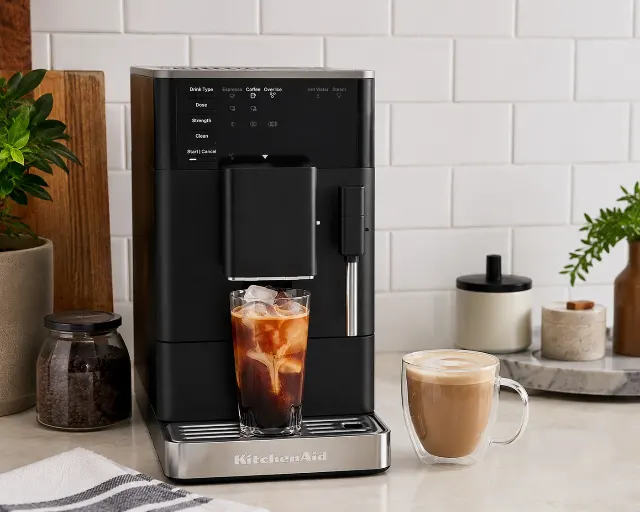
KitchenAid Fully Automatic Espresso Machine KF2 with 6 Hot and Iced Coffee
The KitchenAid KF2 makes excellent, consistent espresso and a uniquely legitimate iced coffee with push-button ease. It's a strong choice for style-conscious buyers who prioritize convenience over the granular control offered by its more complex rivals.
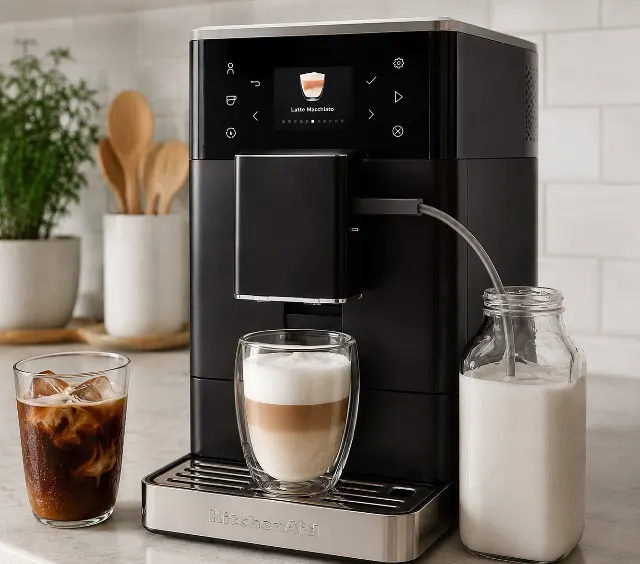
KitchenAid Fully Automatic Espresso Machine KF3 with 15+ Hot and Iced Coffee Options
The KitchenAid KF3 delivers one-touch espresso and a novel iced coffee feature, but its value hinges on prioritizing convenience over the customizability found in rivals.
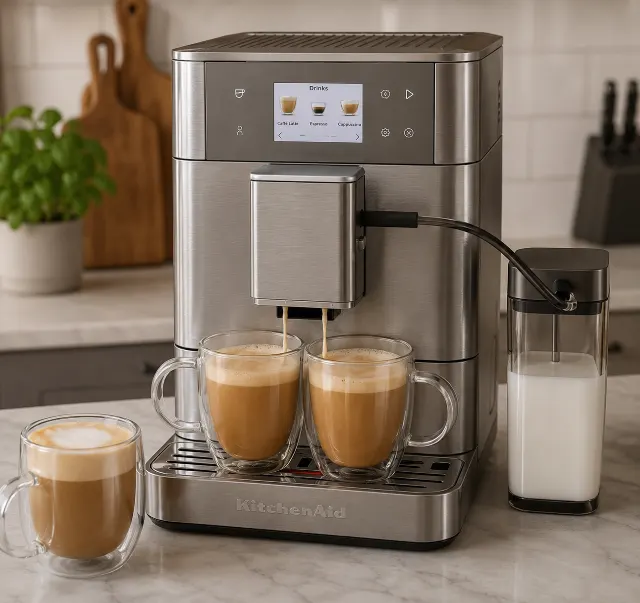
KitchenAid Fully Automatic Espresso Machine KF7 with Milk Attachment
A super-automatic espresso machine built with KitchenAid's signature die-cast metal heft, the KF7 delivers consistent, one-touch espresso and milk drinks but demands a rigorous cleaning routine to maintain its performance over time.
KitchenAid Fully Automatic Espresso Machine KF6
A superautomatic espresso machine that nails the basics for beginners, delivering consistent shots and simple milk drinks from a beautiful, durable chassis. Its primary tradeoff is a premium price for internal components shared with less expensive brands and a milk system that demands diligent cleaning.