Breville Barista Pro Review
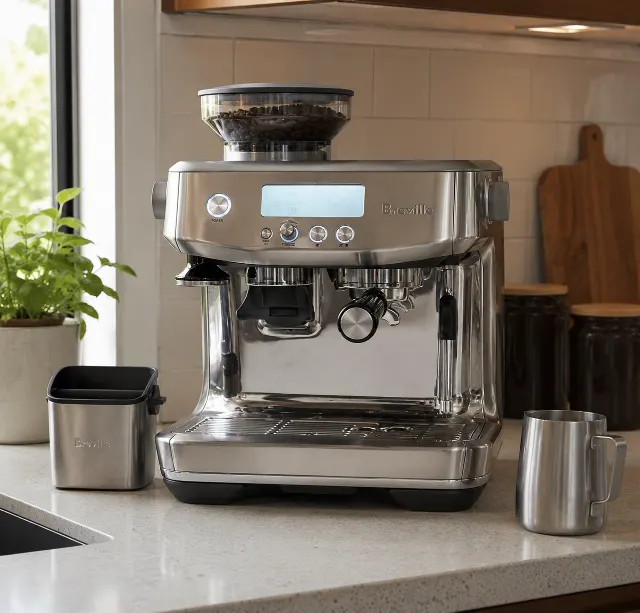
The detail spec sheets miss
THE X-FACTOR: The ThermoJet heater's speed fundamentally changes the morning routine. You can pull a shot and steam milk before a traditional E61 group head machine has even finished its 20-minute pre-heat cycle.
How we rated it
- Value
- ★★★★★ ★★★★★ 4.0
- Quality
- ★★★★★ ★★★★★ 4.3
- Ease of use
- ★★★★★ ★★★★★ 4.6
- Durability
- ★★★★★ ★★★★★ 4.2
What we like
- ✓ThermoJet heating system is ready for extraction in 3 seconds, a massive workflow improvement over thermocoil systems.
- ✓Intuitive LCD interface provides clear feedback on grind size and shot time, simplifying the dialing-in process for beginners.
- ✓Powerful steam wand with a four-hole tip produces excellent microfoam for latte art, outperforming many competitors in its class.
- ✓Integrated conical burr grinder offers 30 stepped settings, providing sufficient range for most espresso beans.
- ✓Digital PID ensures precise and stable water temperature, a critical factor for consistent shot flavor.
What could be better
- ✕The integrated grinder is a performance bottleneck and cannot be upgraded or bypassed, limiting long-term potential.
- ✕Absence of a pressure gauge removes crucial visual feedback during extraction, a feature present on the cheaper Barista Express.
- ✕The 54mm portafilter size restricts choices for high-quality third-party accessories like tampers and precision baskets.
- ✕Internal plastic components, particularly in the group head assembly, raise concerns about long-term durability versus all-metal machines.
Specifications
| Type | All-in-One Semi-Automatic |
|---|---|
| Boiler System | ThermoJet (Thermo-coil) |
| Portafilter Size | 54mm |
| Pump Pressure | 15 Bar Italian Pump (delivers ~9 Bar at group head) |
| Steam Wand | Manual, 4-hole tip |
| Built-in Grinder | Integrated Steel Conical Burr Grinder |
| Water Tank | 2 Liters (67 oz) |
| Heat-up Time | 3 seconds |
| Warranty | 1 Year Limited Product Warranty (US/Canada), 2 Year Repair, Replace or Refund Guarantee (UK) |
You bought the good beans. You watched the videos. You ground them fresh, tamped perfectly level, and locked in the portafilter. You hit the button, and the shot runs way too fast, producing a sour, watery mess. Hitting the ideal 9-bar extraction pressure feels like a dark art. This cycle of frustration is what sends people searching for a machine like the Breville Barista Pro, which promises to simplify the variables without completely taking over.
The Breville Barista Pro BES878 is an all-in-one appliance that integrates a conical burr grinder directly into a capable espresso machine. Its entire design philosophy is built around reducing the number of moving parts in your coffee corner. It’s for the person who wants to make a legitimate flat white before their first morning meeting, not the hobbyist who enjoys the ritual of weighing beans for a separate grinder.
Its core tradeoff is clear: you gain immense convenience and speed at the cost of long-term flexibility. The built-in grinder is permanently attached to your espresso machine's fate. You cannot upgrade one without replacing the other. For many, that’s a perfectly acceptable pact. For others, it’s a dealbreaker they only recognize a year into ownership. This review is built to help you decide which camp you’re in before you buy.
A quick primer
At its heart, the Breville Barista Pro is a single-boiler machine using a proprietary ThermoJet heating system. This is its defining feature. Unlike the older thermocoil in the Breville Barista Express Espresso, which can take a minute or more to come to temperature, the ThermoJet is ready for extraction in a legitimate 3 seconds. This speed is its primary advantage and the main reason to choose it over its older sibling.
An intuitive LCD screen replaces the Express's analog pressure gauge, providing feedback on grind size, grind time, and shot duration. This digital interface makes the process of 'dialing in' a new bag of coffee far less mysterious for a beginner. The machine uses a 54mm portafilter, a Breville standard that is smaller than the 58mm commercial size, which limits third-party accessory choices. Breville's marketing emphasizes cafe-quality results, but it's crucial to understand this is a prosumer appliance, not a commercial one. The spec sheet implies a seamless path to perfect espresso. What owners report is a much faster learning curve than a fully manual setup, but a curve nonetheless.
Build quality & reliability
Build Quality: ★★★★☆ (4.3/5)
The machine presents well, with a brushed stainless steel body that feels substantial on the counter. Key touchpoints like the portafilter have a satisfying heft. However, beneath the metal exterior, a significant number of internal components, including the group head collar and some tubing, are plastic. This is a common cost-saving measure in this price tier, but it raises valid questions about long-term durability compared to machines with all-metal pathways.
Long-term Reliability: ★★★★☆ (4.1/5)
Long-term owner feedback shows the Breville Barista Pro is generally reliable for the first three to five years with proper maintenance. The most common failure point is the integrated grinder, which can clog or fail, especially with very oily, dark-roast beans. The second is the solenoid valve, which can stick over time, causing leaks. The silicone group head gasket is a consumable part that will need replacement every 12-18 months, a minor but recurring cost of ownership. Breville's warranty service is decent, but out-of-warranty repairs can be expensive, often approaching the cost of a remanufactured Breville Barista Pro.
Where it shines
Speed is the headline benefit. The 3-second heat-up time delivered by the ThermoJet heating system is not marketing fluff; it fundamentally changes the morning workflow. You can go from a cold machine to a finished latte in under two minutes. For anyone upgrading from a traditional boiler machine that requires a 15-20 minute warm-up, this feels revolutionary. The transition between brewing and steaming is also exceptionally fast, a key weakness of many single-boiler designs.
The user interface is another major strength. The LCD screen provides clear, actionable information that helps a beginner understand the relationship between grind size and shot time. Having 30 stepped settings on the grinder, controlled by a simple dial, makes adjustments methodical. While it lacks the infinite fine-tuning of a stepless grinder, it provides enough range for most espresso beans and prevents newcomers from getting hopelessly lost. The digital PID temperature control, adjustable in small increments, also provides a level of stability that older, less sophisticated machines lack, leading to more consistent shot flavor.
Steam power is surprisingly robust for a machine in this class. While it won't match a dual boiler machine, the wand produces fine-pored microfoam capable of legitimate latte art. It's a significant step up from the panarello-style wands found on many entry-level machines, which create stiff, bubbly foam. The four-hole steam tip helps create a better vortex in the milk pitcher than the single-hole tips on some rivals.
Buy this if: You live in an apartment with limited counter space, your mornings are rushed, and you want to make milk drinks that are significantly better than a pod machine can produce. The all-in-one design is your biggest asset, and you'd rather buy this than a separate Gaggia Classic Pro and Baratza Encore ESP grinder.
The annoyances
The biggest compromise is the built-in grinder. While convenient, it's the machine's ultimate bottleneck. It has a tendency to clog with oily beans, and its 30 stepped settings can sometimes mean the perfect grind size is frustratingly *between* two clicks. Overlooked detail: the grinder retains a non-trivial amount of coffee between uses, meaning your first shot of the day contains stale grounds from yesterday unless you purge it, which wastes beans. This is a common issue with integrated grinders, and the Barista Pro is no exception.
A recurring complaint in owner reviews is the lack of a pressure gauge. The cheaper Barista Express has one, and its absence on the more premium Pro is a baffling omission. Without it, you have no visual feedback during the 9-bar extraction, making it harder to diagnose a bad shot. Is your puck prep the problem, or is the machine's pressure inconsistent? You're left guessing. This forces a reliance on timing and volume alone, which is a less complete picture of what's happening.
The 54mm portafilter ecosystem is another constraint. While Breville provides decent included accessories, the market for high-quality third-party tampers, distribution tools, and precision baskets is overwhelmingly focused on the 58mm commercial standard. This limits your ability to upgrade and experiment down the line. Finally, the rear placement of the 2-liter water tank is inconvenient, requiring you to pull the machine out from under cabinets to refill it.
Skip this if: You are a coffee hobbyist who enjoys tinkering and plans to upgrade components over time. The integrated grinder is a dead end. You should instead consider a setup like a Rancilio Silvia paired with a dedicated espresso grinder, which offers a higher performance ceiling and modularity for a similar total investment.
How owners actually use it
The daily routine settles quickly. Most users find a favorite bean and stick with it, minimizing the need to constantly re-dial the grinder settings. The programmed volumetric shot buttons are often ignored in favor of manual mode, where the user starts and stops the shot based on weight using a separate scale. This is the single biggest step users take to improve consistency, moving beyond the machine's factory presets within the first month.
What most reviews miss is the impact of the ThermoJet on milk steaming workflow. Because it heats so quickly, users often steam their milk *first*, then immediately purge the system and pull their espresso shot. This is the reverse of the traditional workflow on boiler machines but works well here and keeps the espresso from dying while you wait for the steam to be ready. It’s a small detail that makes a big difference in daily use.
One feature that gets less use than expected is the hot water dispenser. While useful for making an Americano, its flow rate is slow, and many owners simply use a kettle instead. The machine's pre-infusion is a key feature for shot quality, but understanding how to manipulate it by holding the shot button is an advanced technique many beginners don't discover for months. Owner feedback splits roughly evenly on the utility of the included 'Razor' trimming tool; about half find it helpful for ensuring a consistent dose, while the other half discard it in favor of a simple weigh-and-tamp routine.
Long-term ownership
This is not a set-and-forget appliance. The cost of ownership extends beyond the initial purchase. Regular maintenance is non-negotiable for both performance and longevity. The machine will prompt you to run a cleaning cycle (backflushing with a tablet) roughly every 200 shots. Descaling, a more involved process to remove mineral buildup, is required every 2-4 months depending on your water hardness. Ignoring these alerts will lead to clogged lines and pressure problems.
The conical burrs in the grinder will dull over time. For a user pulling two double shots per day, expect a noticeable decline in grind consistency after about three to four years, requiring a burr replacement. The hidden cost that surprises many is water filters. The in-tank charcoal filter needs to be replaced every two months to prevent scale buildup, which is the number one killer of espresso machines. While not expensive individually, this adds to the long-term cost.
A realistic lifespan for a well-maintained Breville Barista Pro is five to seven years before a significant repair is likely needed. This is typical for consumer-grade appliances in this category but falls short of the decade-plus lifespans expected from more robust, commercial-style machines like a Lelit Mara X. That said, one thing the spec sheet doesn't resolve is the availability of parts. Breville's parts ecosystem is better than many competitors, making DIY repairs more feasible for those so inclined.
How it stacks up to rivals
The most common comparison is with its sibling, the Breville Barista Express Espresso. The Pro is the clear winner on speed and user interface. Its 3-second ThermoJet heat-up time and LCD screen justify the price difference for anyone who values a streamlined morning routine. The Express, with its slower thermocoil and analog gauge, is a better budget alternative for those with more patience.
Against the De'Longhi La Specialista Maestro Espresso, the Barista Pro feels simpler and more focused. The De'Longhi adds features like smart tamping and a separate milk frothing system, but its workflow can feel more complex. Verified buyers note the Barista Pro's traditional steam wand offers more manual control for latte art than the automated systems on some competitors, including Breville's own Barista Touch.
For those considering a major step up, the Breville Oracle Jet offers a glimpse into the super-automatic world. The Oracle automates grinding, dosing, and tamping, removing the biggest sources of user error. It's a dual boiler machine, allowing simultaneous brewing and steaming. However, it costs significantly more and removes much of the hands-on craft that Breville Barista Pro users often enjoy learning. The Barista Pro occupies a sweet spot between full manual control and push-button convenience.
Who should pick it up
Best for: The coffee enthusiast early in their journey who wants an all-in-one solution that simplifies the complex variables of espresso without sacrificing the hands-on feel of pulling a shot and steaming milk. It's perfect for the person upgrading from a Nespresso machine who wants to learn the craft on a forgiving platform.
Not ideal for: The seasoned hobbyist who already owns a high-quality standalone grinder or the buyer who prioritizes repairability and longevity above all else. The integrated grinder's performance ceiling and the use of internal plastic components will be frustrating limitations for this user. A more modular system is a better long-term investment for them.
The final word
The Breville Barista Pro remains a defining machine in the home espresso market because it correctly identifies its target user: someone who wants better coffee now, not after a six-month apprenticeship. Its speed and intuitive interface are its strongest assets, successfully lowering the barrier to entry for making genuinely good lattes and cappuccinos at home.
However, its all-in-one design is both its greatest strength and its most significant weakness. The convenience is immediate, but the performance ceiling is permanent. It's a fantastic learning tool, but one that a dedicated enthusiast will eventually outgrow. It's an appliance, not a lifelong hobby machine, and there is absolutely nothing wrong with that.
For the right person, the Breville Barista Pro is the fastest path from bean to quality latte on a busy morning.
Who gets the most from it
Ideal for the aspiring home barista living in a small kitchen who wants to graduate from pods but isn't ready for a separate grinder and the associated counter space sacrifice. Skip this if you already own a quality standalone grinder or plan to upgrade within two years; the integrated grinder cannot be bypassed.
Reasons to pick it
The Barista Pro solves the 'I don't have 20 minutes for my machine to warm up' problem. Its ThermoJet system delivers near-instant readiness, a decisive advantage over the slower thermocoil in the Breville Barista Express Espresso. For latte drinkers, this means less waiting between brewing and steaming.
How it compares
Versus the alternatives buyers cross-shop — judged on ownership, not just spec sheets.
| Alternative | Ease of use | Maintenance | Durability | Value | Best for |
|---|---|---|---|---|---|
| Breville Barista Pro (this pick) | LCD screen and stepped grinder simplify dialing in for novices. | Prompts for backflushing and descaling; grinder requires periodic deep cleaning. | Stainless steel exterior with internal plastic parts; 5-7 year expected lifespan. | Excellent for an all-in-one, but the integrated grinder limits long-term value. | The space-conscious beginner prioritizing speed and a guided learning experience. |
| Breville Barista Express Espresso | Steeper learning curve due to analog pressure gauge and fewer grind settings. | Similar cleaning cycles to the Pro, though fewer electronic components to fail. | Slightly older design but comparable build; similar lifespan expectations. | Higher price-to-performance for patient users who don't need instant heat-up. | The budget-conscious buyer willing to trade speed for a lower entry cost. |
| De'Longhi La Specialista Maestro Espresso | More complex with smart tamping and dual heating systems; more features to learn. | More components (e.g., auto-frother) to clean and potentially service. | Similar mixed metal/plastic construction common in this category. | Packs in features, but value depends on whether you use them all. | The user who wants more automation and features and is less focused on traditional workflow. |
| Breville Oracle Jet | Near super-automatic; automates grinding, dosing, and tamping, removing user error. | More complex internals require diligent adherence to cleaning protocols. | Heavier build, but more complex electronics create more potential failure points. | Premium tier; value is in convenience and consistency, not raw shot potential. | The user with a large budget who wants push-button consistency without the craft. |
How it scores on what matters
| Product | Espresso shot quality | Milk steaming & microfoam | Consistency shot-to-shot | Ease of dialing in | Heat-up & workflow speed | Maintenance burden | Verdict |
|---|---|---|---|---|---|---|---|
| Breville Barista Pro (this pick) | Good | Very good | Good | Very good | Excellent | Fair | Fastest workflow, but grinder limits ultimate shot quality. |
| Breville Barista Express Espresso | Good | Good | Fair | Fair | Fair | Fair | Slower and less consistent, but a capable budget start. |
| De'Longhi La Specialista Maestro Espresso | Good | Good | Very good | Good | Good | Weak | Feature-rich and consistent, but more complex to maintain. |
| Breville Oracle Jet | Very good | Excellent | Excellent | Excellent | Very good | Weak | Superb consistency and ease, but at a premium cost. |
Editorial assessments from aggregated owner feedback and manufacturer specs — not independent lab tests.
Frequently asked questions
Is the Breville Barista Pro worth it in 2026?
For those prioritizing speed and a guided learning experience, yes. Its 3-second ThermoJet heating is a significant advantage over slower machines. However, if you plan to get deep into the hobby, a separate grinder and machine offer better long-term value and performance.
Has Breville discontinued the Barista Pro?
No, the Breville Barista Pro (model BES878) has not been discontinued. It remains a core model in their lineup, effectively positioned as the modern upgrade to the classic Barista Express and a step below the automated Barista Touch, and is widely available.
What is the key difference between the Breville Barista Express and the Pro?
The primary differences are the heating system and the user interface. The Pro features the near-instant ThermoJet heater, while the Express uses a slower thermocoil. Additionally, the Pro's LCD screen provides much clearer digital feedback than the Express's analog pressure gauge.
Which Breville Barista machine is considered the best?
Defining the 'best' depends entirely on the user's needs. The Barista Pro is best for speed and usability. For maximum convenience with automated milk frothing, the Barista Touch is superior. The Barista Express remains the best entry-level value proposition for those on a tighter budget.
What are the most common problems with the Barista Pro?
Owners most frequently report the integrated grinder clogging, particularly when using oily, dark-roasted coffee beans. Another common issue is inconsistent shot extraction without careful puck preparation, a problem made harder to diagnose by the lack of a pressure gauge.
What is the portafilter size for the Breville Barista Pro?
The Barista Pro uses a 54mm portafilter, which is characteristic of Breville's consumer line. This is smaller than the 58mm commercial standard, meaning you must buy 54mm-specific accessories like tampers and distribution tools, which are less common than their 58mm counterparts.
People also ask
- Is the Breville Barista Pro worth it?
- Did Breville discontinue the Barista Pro?
- What is the difference between Breville Barista Express and Pro?
- Which Breville barista is the best?
- What are the common problems with the Barista Pro?
- What size is the Breville Barista Pro portafilter?
- Is the Breville Barista Pro worth the money in 2026?
- What is the main difference between the Breville Barista Express and the Pro?
- Which Breville Barista machine is the best overall?
- What are the most common problems with the Breville Barista Pro?
- How long should a Breville Barista Pro last?
- Is the Breville Barista Pro good for beginners?
You might also like
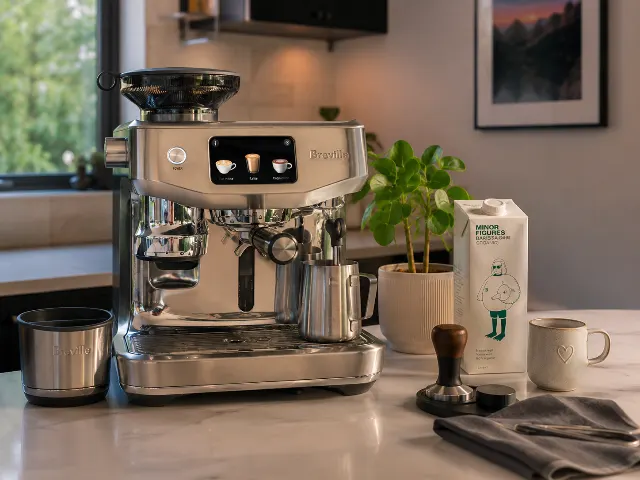
Breville Oracle Jet
The Breville Oracle Jet trades absolute manual control for morning convenience, delivering cafe-quality extraction through automated tamping and precise milk texturing.
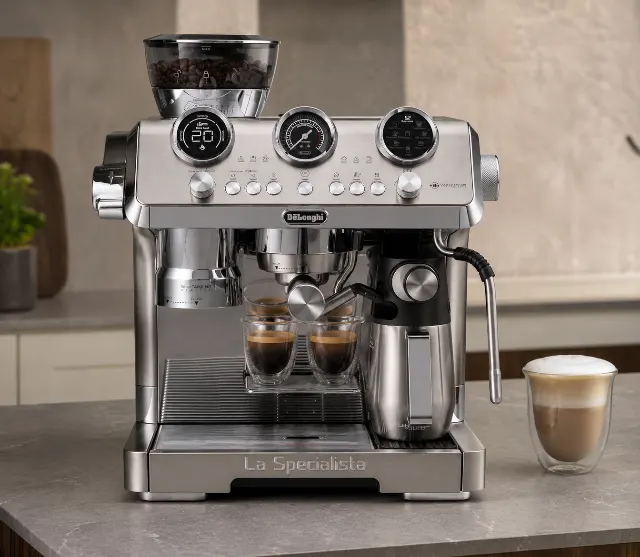
De'Longhi La Specialista Maestro Espresso
The De'Longhi La Specialista Maestro excels at convenient, repeatable espresso with a built-in tamper, but its grinder and plastic components betray its premium price point for purists.
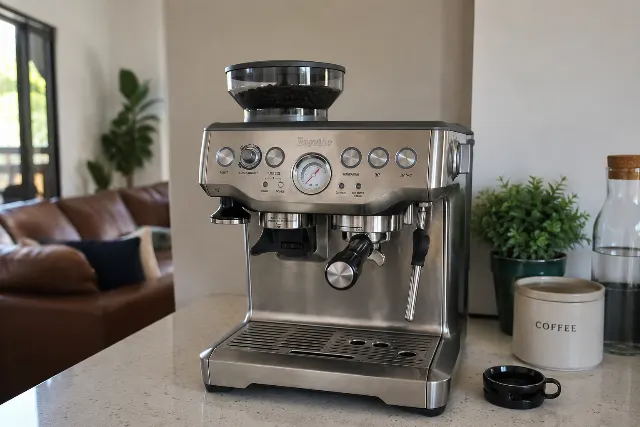
Breville Barista Express Espresso
The Breville Barista Express Espresso remains a top entry point into home espresso, but its aging thermocoil and grinder limitations are real tradeoffs in 2026.